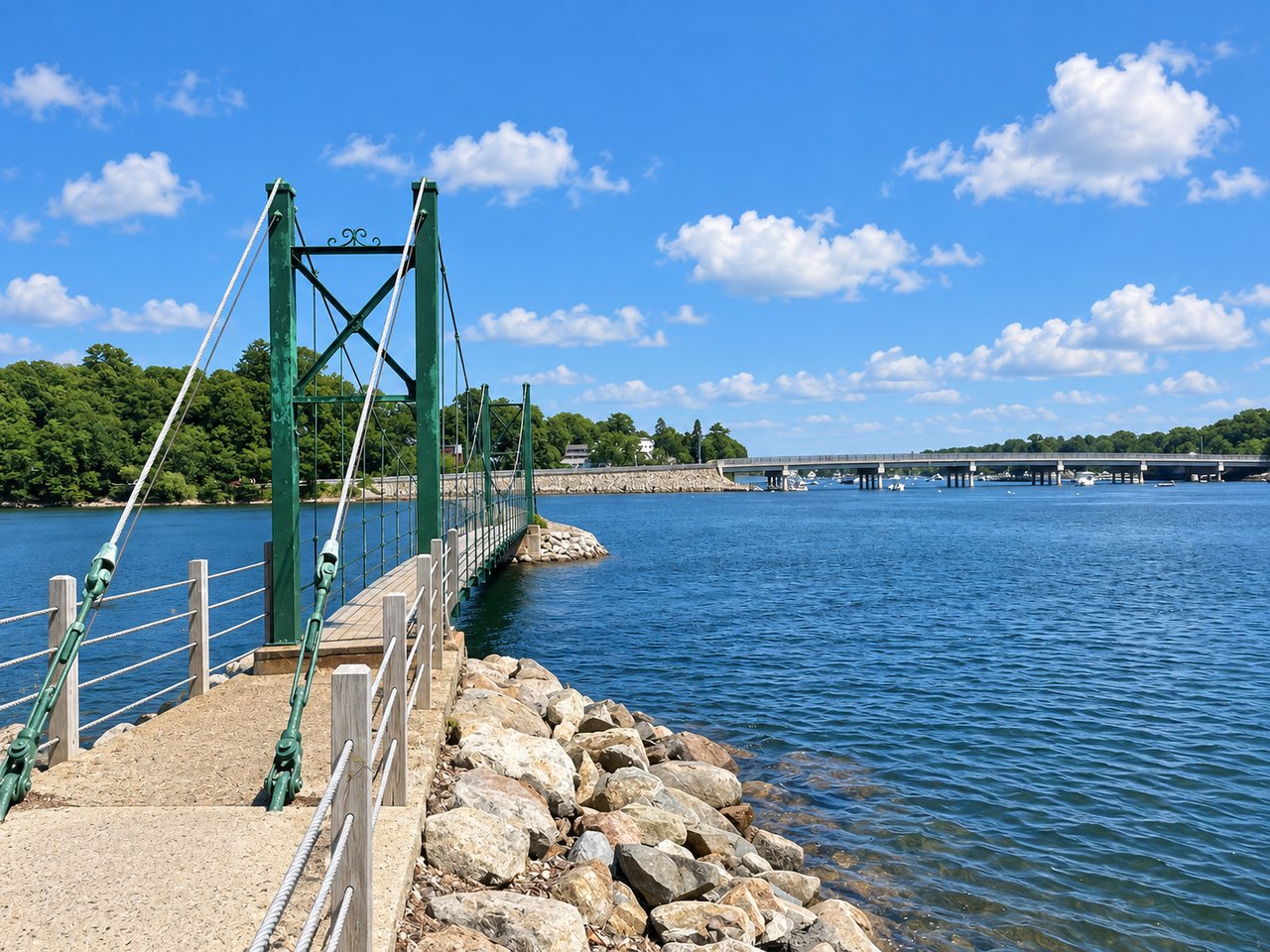
Travel write-ups often focus on the 75 feet of decking: walk to the bridge, feel it wiggle, take a photo, and turn around. That's a fine afternoon for a weekend visit.
The bridge is more than a destination; it's a hinge. On one side is a working harbor, salt marsh, and the tide going in or out under lobster boats. On the other is a quiet, shaded, 17-acre woodland that has nothing to do with the water at all. The bridge is just the four seconds you spend crossing from one kind of walk into a completely different one, and which direction you take it depends on what kind of morning you're having.
Two Walks Wearing One Name
Start at York Harbor Beach and head out on Fisherman's Walk and you're on a paved path tracing the York River, close enough to the water to watch working lobster boats and see the tide move across the flats. It's roughly half a mile of open shoreline, framed by the coastal homes and landscaping that give this stretch of Route 103 its character, before the path narrows onto a causeway and delivers you to Barrells Millpond.
Cross the pond on the Wiggly Bridge, built in the 1930s and often cited as the smallest suspension bridge in the country, and the walk changes entirely. You're now in Steedman Woods, a wooded preserve with close to a mile and a half of interior trails, shaded, still, and built for birding more than sightseeing. It loops back to the causeway, so the standard route is an out-and-back: harbor, then woods, then harbor again. Total distance gets reported anywhere from 1.4 to 1.9 miles depending on which stretch a given source is measuring, which tells you something useful on its own. This isn't a manicured, single-purpose trail with a fixed trailhead. It's a stitched-together route that different people enter from different points for different reasons, and everyone's version of "the walk" is a little different.
That's the part worth sitting with. Somebody walking a dog before work might do Fisherman's Walk alone and skip the woods entirely. Somebody chasing shade on a July afternoon might park near Steedman Woods and never touch the harbor side. The bridge is where those two errands cross paths, not where either of them ends.
Parking Options for the Walk
Parking is one practical detail to plan for, and it's worth being specific about where.
The small lot off Lilac Lane, the access point closest to the Wiggly Bridge and Steedman Woods side, is permit-only. It's the closest lot to the bridge itself, and parking there is limited. Trail guides recommend arriving early if you're counting on getting a spot.
One alternative is to approach from the other end. Park in downtown York Village, about a 10 to 15 minute walk from the bridge, or start from the York Harbor Beach side where Fisherman's Walk begins, and you reach the same bridge without using the Lilac Lane permit-only lot. It adds ten minutes. It also means you get the full harbor stretch of the walk instead of skipping straight to the woods.
What the Walk Actually Connects You To
The reason this loop matters beyond its own scenery is what sits at either end of it.
Head north from the bridge through Steedman Woods and you're a short walk from Old York's historic core: the Old Gaol, the First Parish Church, the Sayward-Wheeler House, the kind of colonial-era landmarks that make this stretch of coastline feel older than a typical beach town. Head south along Fisherman's Walk toward the beach and you land in a different register entirely, one built around two seasonal institutions that define how York Harbor spends its summer.
The York Harbor Reading Room sits on the coast overlooking Harbor Beach, right where Fisherman's Walk begins. It's a private club, open seasonally from May through October, with access restricted to members during the peak months of July and August. It's been part of the neighborhood's social fabric since the 1890s, and it borders the Hartley Mason Reserve, another piece of protected shoreline that residents use as a cut-through and a wedding backdrop in equal measure.
A short distance inland, Trinity Church runs a summer concert series that's become its own kind of local institution, with Sunday evening performances that draw a mixed crowd of members and neighbors rather than tourists working through a checklist. The 2026 lineup opened with Joyce Andersen and Harvey Reid, an Americana duo, on June 21, followed by the Coastal Winds Clarinet Quartet on June 28, part of a schedule that runs through the summer months.
None of this is coincidental. The walking loop, the Reading Room's season, and Trinity's concert calendar all run on the same clock, roughly May through October, and they all sit within a few minutes of each other. The bridge you cross on a Tuesday morning dog walk is the same stretch of shoreline you'd walk past on your way to a Sunday concert. York Harbor's summer doesn't have a single center. It has this corridor, and everything else arranges itself around it.
Why the Quiet Half of the Walk Isn't Going Anywhere
Here's the detail that changes how you might think about the woods side of the loop specifically. Steedman Woods isn't a town park maintained on whatever budget survives a given year's appropriations. It's a preserve gifted to the York Historical and Improvement Society in 1978, protected as conservation land rather than held as developable town property. That distinction matters more than it sounds like it should. Plenty of green space near a desirable coastline eventually faces pressure to become something else. This particular 17 acres was taken off that table almost fifty years ago, by deliberate donation, specifically so that it would stay a woodland loop and nothing more.
That's part of why the walk feels the way it does on the Steedman Woods side. It's a wooded preserve rather than a manicured public park; for a long time, it was privately held.
A Route with More to Explore
The payoff of this walk extends beyond the bridge: a loop that changes character block by block, that connects a working harbor to a protected woodland to a historic village core to a private summer club to a church concert series, all inside two miles, and all still running on the same seasonal calendar it's kept for generations.
If you already call York Harbor home, you probably have your own version of this walk figured out by now, your own preferred direction, your own preferred parking spot. If you're getting to know the neighborhood, or thinking about how a summer here actually unfolds day to day, it's worth understanding how this route connects several neighborhood destinations and serves as the neighborhood's spine.
For homeowners weighing what a property near this corridor is actually worth, or for anyone curious how walkable access to the harbor and the village core factors into value in this part of York, the team at Great Seacoast Homes knows this stretch of coastline block by block. If you're considering a move here or wondering what your own home along this route might be worth, request a personalized home valuation and get a read on the market from people who walk it too.
This article is general information, not legal, tax or financial advice. Consult a qualified professional about your situation.