Mortgage rates have moved back above 7%, creating a new affordability challenge for homebuyers and prompting more borrowers to explore alternatives to the traditional 30-year fixed-rate mortgage.
For buyers considering a home in Southern Maine, particularly in higher-priced coastal communities such as Kittery, York, Cape Neddick, Ogunquit, Wells, Kennebunk, and Kennebunkport, understanding these financing options can make a meaningful difference in both purchasing power and monthly costs.
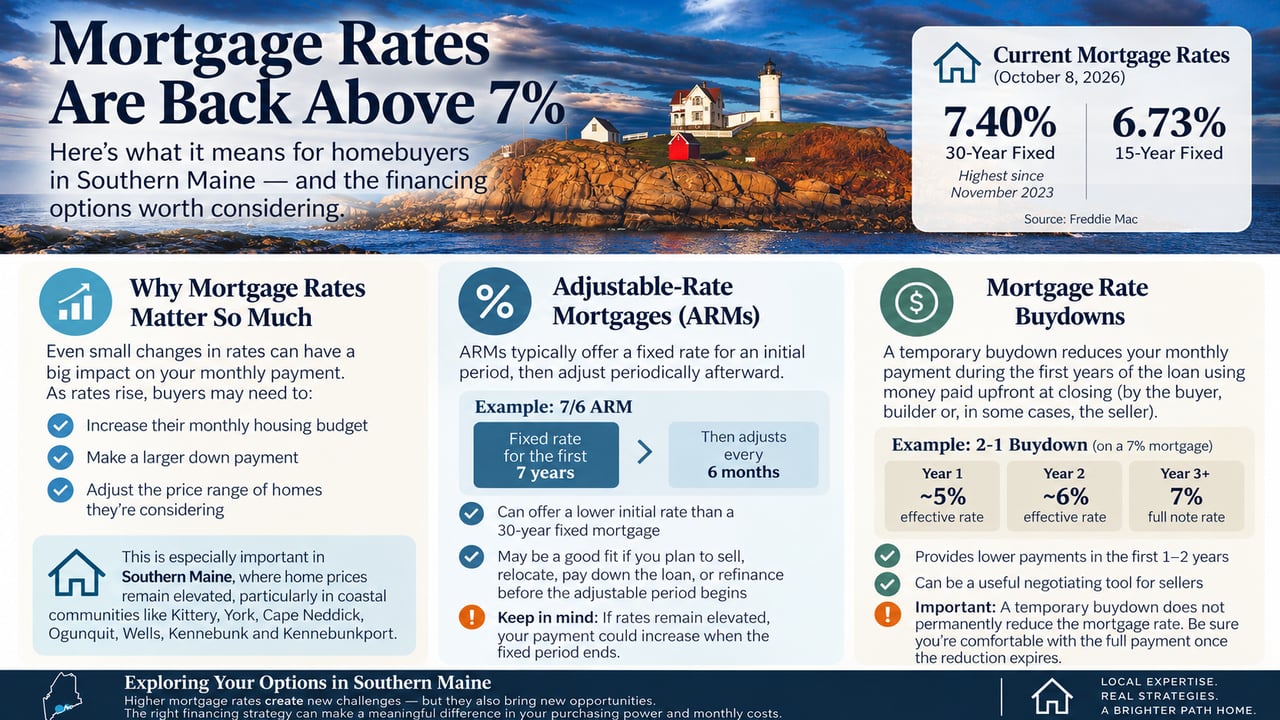
According to Freddie Mac, the average rate for a 30-year fixed-rate mortgage reached 7.40% on October 8, 2026, its highest level since November 2023. The 15-year fixed-rate mortgage averaged 6.73%.
Higher mortgage rates do not necessarily mean buyers need to step out of the market altogether. Instead, they are changing the way some buyers finance a purchase—and creating new considerations for sellers as well.
Why Mortgage Rates Matter So Much to Buyers
Even relatively small changes in mortgage rates can have a significant effect on monthly payments.
As rates rise, buyers financing a home may either need to increase their monthly housing budget, make a larger down payment, or adjust the price range of the homes they are considering.
That impact becomes particularly noticeable in Southern Maine, where home prices remain elevated, and many coastal properties trade well above statewide averages.
For buyers, the important question is increasingly not simply, “What is the mortgage rate?” but rather, “What will my total monthly payment be, and what financing structure makes the most sense for my circumstances?”
That shift has brought renewed attention to several financing strategies.
Adjustable-Rate Mortgages Are Getting Another Look
One alternative attracting more interest is the adjustable-rate mortgage, or ARM.
Unlike a traditional fixed-rate mortgage, an ARM generally offers a fixed interest rate for an initial period and then adjusts periodically afterward.
A 7/6 ARM, for example, typically provides a fixed rate for the first seven years and then adjusts every six months.
According to data cited by Homes.com, adjustable-rate mortgages recently accounted for roughly 10% of mortgage applications, as borrowers looked for ways to secure an initial rate below prevailing 30-year fixed rates.
For the right buyer, that can be attractive.
Someone purchasing a property with the expectation of selling within several years, relocating, paying down the loan substantially, or refinancing before the adjustable period begins may find an ARM worth considering.
The tradeoff is uncertainty.
If mortgage rates remain elevated when the fixed period expires, the borrower's interest rate—and monthly payment—could increase.
An ARM should therefore be evaluated based on what a buyer can comfortably afford if the rate eventually adjusts, not solely on the lower introductory payment.
Mortgage Rate Buydowns Could Become More Important
Another strategy receiving renewed attention is the mortgage rate buydown.
A temporary buydown reduces a buyer's mortgage payment during the first years of the loan by using money paid upfront at closing. That money may be contributed by the buyer, builder or, in some transactions, the seller.
One common structure is a 2-1 buydown.
Under that arrangement, the effective mortgage rate is generally reduced by two percentage points during the first year and one percentage point during the second year before returning to the full note rate in year three.
For example, if the underlying mortgage rate were 7%, the buyer's payment could initially be calculated at approximately 5% in year one and 6% in year two before reaching the full 7% rate.
The important distinction is that a temporary buydown does not permanently reduce the underlying mortgage rate.
Buyers should therefore be financially comfortable with the full payment once the temporary reduction expires.
A Buydown Can Also Be a Seller Strategy
Mortgage-rate buydowns are not only a buyer consideration. They may also become an increasingly useful negotiating tool for sellers.
In certain circumstances, contributing toward a buyer's financing costs can be more effective than simply reducing the listing price.
Consider a buyer who likes a property but is concerned primarily about the monthly payment. A seller concession applied toward a rate buydown or closing costs may address that concern more directly than an equivalent reduction in purchase price.
This can be particularly relevant when a property has been on the market longer than expected or when a seller is competing against similar homes.
Every transaction is different, and lending rules place limits on seller concessions depending on the type of mortgage and down payment. But in today's market, sellers should understand that price is only one component of negotiation.
Financing terms can matter as well.
What About Interest-Only Mortgages?
Some higher-net-worth buyers are also exploring interest-only mortgages, particularly in higher-priced markets.
During the interest-only period, the borrower pays interest without reducing the principal balance.
That can substantially lower the initial monthly payment, but it comes with important risks. Once the interest-only period ends, payments can increase considerably because the borrower must begin repaying principal as well.
These loans may make sense in very specific financial situations, but they are generally more complex than conventional financing and require careful analysis with a qualified lender and financial advisor.
For buyers purchasing luxury or second homes in Maine, however, it is worth knowing that conventional 30-year financing is not the only option available.
Higher Rates May Create Opportunities for Well-Prepared Buyers
Rising mortgage rates create an interesting dynamic in the housing market.
They make borrowing more expensive, but they can also remove some competing buyers from the marketplace.
That can create opportunities for purchasers who remain financially prepared.
A home that might have attracted multiple offers in a lower-rate environment could potentially offer more room for negotiation on price, closing costs, inspection terms, or financing concessions.
That does not mean every property has suddenly become negotiable.
Exceptional coastal homes, waterfront properties and well-priced homes in desirable Southern Maine communities can still attract considerable demand.
But today's market increasingly rewards buyers who are financially prepared and able to evaluate both the property and the structure of the transaction.
Get Pre-Approved Before Beginning Your Search
One of the most practical steps buyers can take in a volatile rate environment is obtaining mortgage pre-approval early.
Pre-approval provides a clearer picture of:
- Your realistic purchasing range
- Estimated monthly payments
- Available mortgage programs
- Down-payment requirements
- How changes in interest rates could affect affordability
It can also strengthen an offer.
When buyers understand their financing before finding a property, they are better positioned to move quickly when the right home becomes available.
Shopping among several lenders can also be worthwhile. Rates, fees, and available loan programs can vary, and Freddie Mac specifically advises borrowers to obtain multiple mortgage quotes.
Don't Try to Perfectly Time Mortgage Rates
It is tempting to postpone a home purchase while waiting for mortgage rates to decline.
The challenge is that neither buyers, sellers, nor economists can reliably predict exactly when that will occur.
Mortgage rates respond to Treasury yields, inflation expectations, economic conditions, and global financial markets, and they can change quickly.
Buyers also need to consider what could happen to housing demand if rates eventually decline.
Lower borrowing costs could bring more buyers back into the market, particularly in desirable areas with limited inventory. That could result in stronger competition for attractive properties.
The better question may therefore be whether the right home is available at a price and monthly payment that fit your financial plan today.
If rates eventually fall, refinancing may be possible, although buyers should never assume future refinancing will be available or economically advantageous.
What This Means for Southern Maine Real Estate
For the Southern Maine market, higher mortgage rates are likely to continue separating properties that are strategically priced and marketed from those that are not.
Buyers are increasingly sensitive to the relationship between purchase price, interest rate, and monthly payment.
Sellers, meanwhile, may need to think more creatively about negotiations.
That could mean considering closing-cost credits, mortgage-rate buydowns or other concessions when appropriate rather than relying exclusively on a price reduction.
In communities such as Kittery, York, Ogunquit, Wells, Kennebunk, and Kennebunkport, however, long-term fundamentals remain important. Coastal location, limited inventory, water access, walkability, architectural quality and scarcity all continue to influence value.
Mortgage rates affect what buyers can afford.
They do not make every property or every local market behave the same way.
The Bottom Line
Mortgage rates above 7% create a real affordability challenge, but they do not eliminate opportunities in the housing market.
Adjustable-rate mortgages, temporary mortgage buydowns and other financing strategies may help some buyers navigate today's higher-rate environment. At the same time, these options involve different levels of risk and should be evaluated carefully with an experienced mortgage professional.
For buyers, preparation and flexibility are increasingly valuable.
For sellers, understanding how financing affects a buyer's decision can open additional avenues for negotiation.
And for both, the most important factor remains the same: real estate is local.
If you are considering buying or selling a home in York, Kittery, Cape Neddick, Ogunquit, or elsewhere along the Southern Maine coast, Great Seacoast Homes can help you evaluate current market conditions, property values, and the strategy that makes the most sense for your particular move.
Mortgage products, interest rates, and qualification requirements vary by lender and borrower. This article is for general real estate information and is not mortgage, financial, tax, or legal advice. Buyers should consult a qualified mortgage professional regarding financing options.